I’ve been looking for specific quotes making the case for digital sovereignty, and came across I'll Get You My Pretty, and Your Little VPN Too!, a very good podcast interview with Lia Holland, the campaigns and communications director of Fight for the Future. I recommend it to anyone considering degoogling! If you are already interested, I’d love to help you so please reach out.
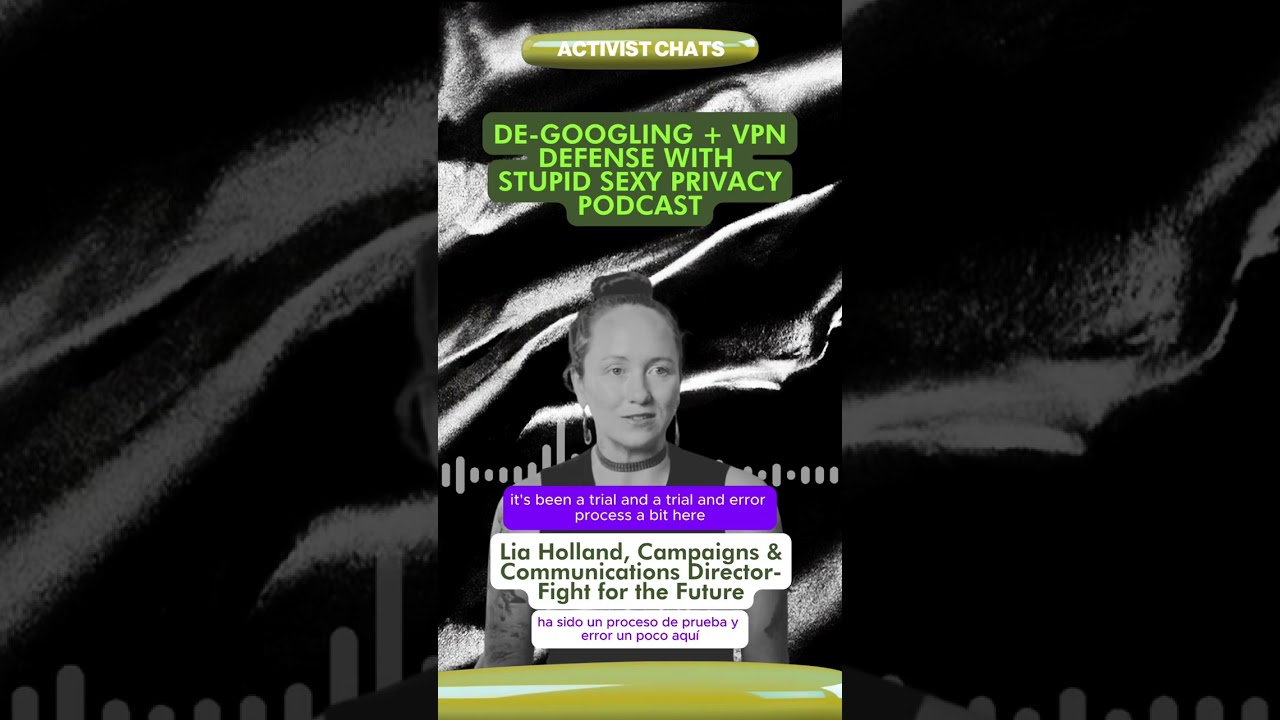
From the interview transcript:
I’ve been using Google for basically my entire adult life. And so my mental construct of what work looks like and how it gets done has actually been defined by this corporation in a way that I wasn’t aware of.
And so, the process of de-Googling for Fight for the Future has also been a process of personal reprogramming for what work looks like and also accepting to a certain extent because I’ll be honest, Google’s tools are really good; and my brain is just absolutely programmed to work with them. So yeah, other things feel slower, other things feel different. I’m having to adapt a lot and… And that’s a process. But every time I confront that like, “I want to get it done faster. be busy, be busy, be busy type of reaction”. When I’m using a non Google product, I think about why I’m doing what I’m doing. And it’s this little moment of like, smugness of like, see, Google, we don’t actually need you.
The main examples Lia talks about are Element, which FFTF switched to from slack, and Signal, which they use for internal calls and for external calls with everyone else who also uses Signal. Signal is not open source and can’t be self-hosted but is generally accepted to (still) be a viable option for secure calling. Certainly better and safer than Facetime, WhatsApp and Google Meet!
Element could quite easily be added to an organization’s digitally sovereign, self-hosted toolkit. Lately Nextcloud also has been improving it’s Talk feature and it’s tightly integrated with the rest of its features so that is also a good option if your organization is using Nextcloud already.
Personally, I like using Nextcloud Talk for calls and using the integrated chat when on the call. I like how for standing calls you can have chat persist, right there where you are talking. But for ongoing long term conversation I prefer writing in Discourse topics like this one. It’s async and persists for the long term so people can refer to it later and jump in anytime to add to the conversation. Discourse supports chat too for ephemeral, direct connection. And it can be set up for both public and private spaces for different groupings of people on a team or in the wider community, all on the same self-hosted, digitally sovereign platform.
The long version with transcript goes into many more topics of interest to privacy minded people, including VPNs:
Excerpt of the relevant portion:
BJ: And let me ask you, I heard that you were, the organization is de-Googling and I’d love to know how that process is going.
Lia Holland: Oh my gosh, it’s so fascinating because I mean, I can just speak personally on it for a minute that I’ve been using Google for basically my entire adult life. And so my mental construct of what work looks like and how it gets done has actually been defined by this corporation in a way that I wasn’t aware of.
And so, the process of de-Googling for Fight for the Future has also been a process of personal reprogramming for what work looks like and also accepting to a certain extent because I’ll be honest, Google’s tools are really good; and my brain is just absolutely programmed to work with them. So yeah, other things feel slower, other things feel different. I’m having to adapt a lot and… And that’s a process. But every time I confront that like, “I want to get it done faster. be busy, be busy, be busy type of reaction”. When I’m using a non Google product, I think about why I’m doing what I’m doing. And it’s this little moment of like, smugness of like, see, Google, we don’t actually need you.
BJ: Yeah, and you know, it’s funny that taking that beat and to think about doing what you’re doing comes up so often on this show, and with a lot of the privacy tips. And so it’s interesting that it’s coming up there. Let me ask you, like, generally speaking, getting off the big tech platforms, what has that process been like?
Lia Holland: Well, we’re lucky enough at Fight for the Future to have a couple of devs on staff. We have an amazing CTO here who builds a lot of our custom tech tools for advocacy and what have you. So, for us, there was like an iterative process of testing alternatives to Google Docs. There was… An assessment of what just makes the most sense for this team in terms of email solutions.
And we’ve already been using things like Element, which is an encrypted and decentralized alternative to Slack.
And just moving into more of those tools and finding the ones that actually can support like real time document collaboration or this one looks pretty, but it doesn’t let you make comments and that’s a problem. It’s been a… It’s been a trial and error process a bit here.
The biggest takeaway, I think, for our dev team is that everybody should be using the same tools the same way. So we’ve been coming together around that a bit more, that fight than we ever had before. And it’s created more cohesion and also just more understanding of each other’s processes, which has been good too.
BJ: Yeah, is there any particular tool, you mentioned Element, are there any particular tools that you’ve come across that have been super helpful that people might be curious to check out?
Lia Holland: Well, I mean, Element is our number one. It’s been incredible as a tool, as a Slack replacement. We are super reliant on it as an org and it has really performed well for us. Little things like we have bots that every time somebody donates to fight for the future, we get a little notification that somebody gave and things like that. And then, I also should just shout out, and I mean, for listeners of this podcast, it’s basic, but like we do all our calls on Signal now, basically, Unless like an external partner wants to use a Google link or a Zoom or what have you. If they’re on Signal and we’re on Signal, we are defaulting to Signal. That’s where we do our group standups every day. We do video calls, screen shares. It is just so impressive how far that team has come with how good their tool is. We can basically do almost anything there.
BJ: Yeah, I can’t recommend Signal enough. I think about some of the local groups that I’m involved with that are still using WhatsApp to tell each other about ICE raids and what’s going on in the community. And getting them to use Signal has been really difficult. I think once they do see it, they start to go, “this is really good.” The light kind of goes off.